A 3-Year-Old Chess Prodigy Makes History
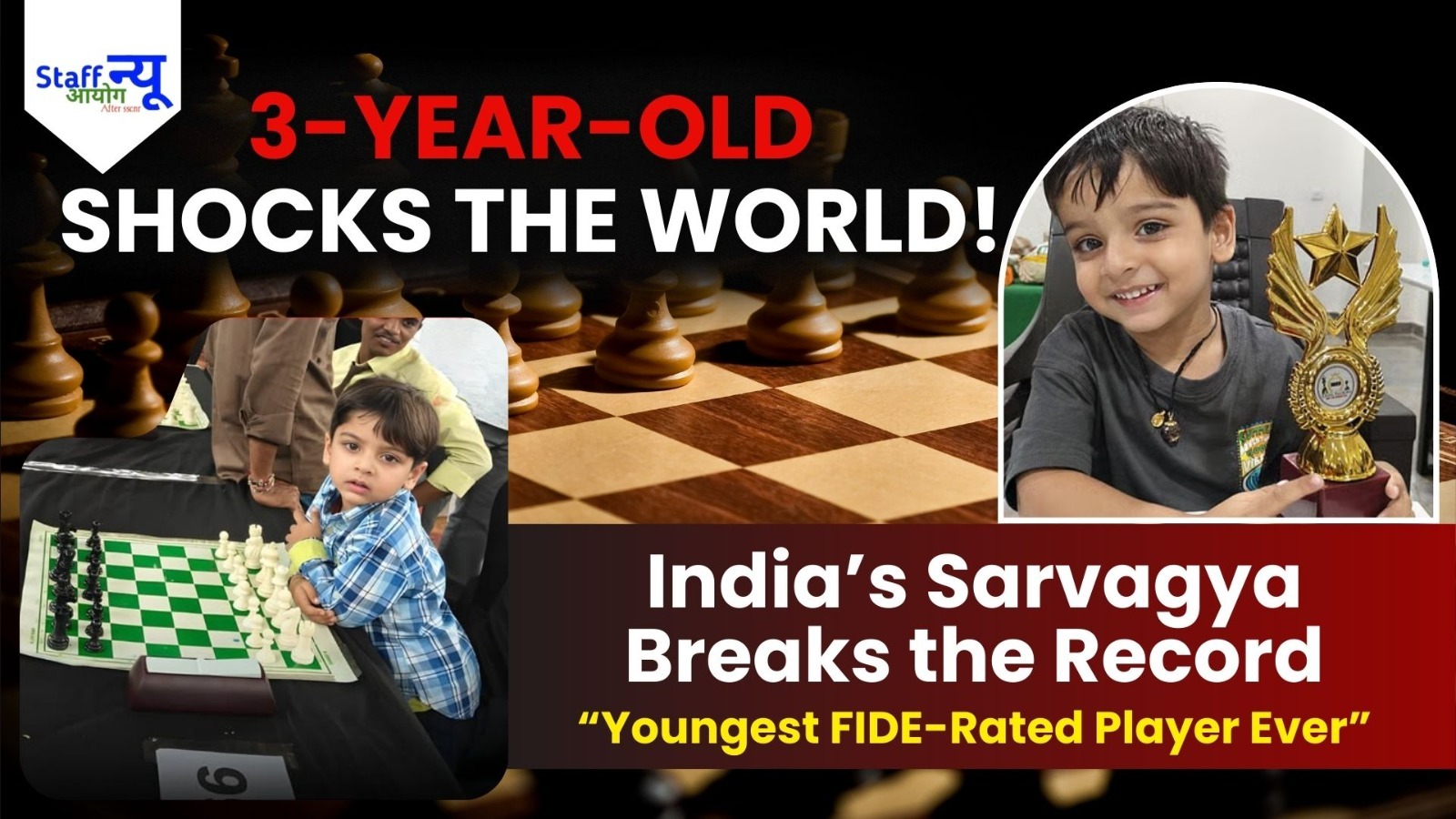
In a milestone that has stunned the chess world, three-year-old Sarvagya Singh Kushwaha from Sagar district, Madhya Pradesh, has become the youngest player ever to receive an official rating from the FIDE (International Chess Federation). At just 3 years, 7 months and 20 days, Sarvagya has broken the previous record — a jaw-dropping feat by any standard.
His first FIDE rating: a remarkable 1572 placing him firmly on the international chess ranking list, and signaling that this is not just a publicity stunt, but real merit.
From Nursery School to Chess Board: How It Began
While other kids of his age are learning nursery rhymes, colours, and how to stack blocks — Sarvagya’s mind has been ticking in 64 squares. As per reports, he started learning chess when he was about two-and-a-half years old.
His family quickly realized his keen interest and potential; what began as playful curiosity soon turned into serious games. Today, despite being in nursery school, Sarvagya reportedly spends four to five hours a day on chess — mixing training sessions at a local cricket (chess-training) centre with online games and tactics practice.
According to his father, Sarvagya was a quick learner — within a week of first being taught, the toddler could name all chess pieces accurately.
| Join Telegram For Fast Update | Join |
His coaching journey started with local trainer Nitin Chaurasia, and under guidance of national instructor Akash Pyaasi. Their stakes: nurture raw talent, without overburdening the child — a balance that seems to be holding so far.
🎯 Climbing the Ranks: What Sparked the Official Rating
Becoming FIDE-rated isn’t about playing a few casual games — there are rules: a player needs to compete in FIDE-approved tournaments and perform against already rated players, sometimes more than once. For a baby-faced toddler, that’s an incredible demand.
Sarvagya didn’t just participate — he excelled. Reports indicate that during tournaments in Madhya Pradesh and Mangaluru, he defeated three internationally rated players, proving his moves were more than just luck or novelty.
Accordingly, on December 2, 2025, his name was officially added to the FIDE rating list — with the 1572 rating. That figure comfortably crosses the minimum threshold (1400) required for “rated” players.
This feat dethrones the previous record-holder, another toddler from India — Anish Sarkar — who had earned a 1555 rating when he was 3 years and 8 months old in late 2024.
🧠 What Sets Sarvagya Apart Beyond Age and Rating
There’s more to this story than just numbers and records. Watching Sarvagya play, many observers have commented on his tactical awareness, calmness, and patience — traits rarely expected from someone so young.
Because of his tiny stature, he often needs little tricks — standing on a chair, or even three stacked chairs — just to reach the board and move his pieces. Yet, once he starts, there’s little sign of childish restlessness. He stays focused, thinks, plans — and often outplays older kids.
His coach Nitin Chaurasia admits that early days of coaching required patience: scolding or strictness could make a 3-year-old break down. So instead of pressure, they used rewards — a toffee or pack of chips for good moves. And even that light-hearted style didn’t stop the kid from showing serious chess sense. “He can hold his own on the board against older kids. You can see his guts when he plays,” says the coach.
📈 What This Means for Indian Chess — And Beyond
For Indian chess, Sarvagya’s meteoric rise is more than a viral headline. It marks a potential paradigm shift — can the seeds of chess excellence now be planted as early as age 2–3? With infrastructure, coaching and parental support, maybe yes.
Already, Madhya Pradesh — his home state — is riding on this momentum. The state’s chess community hopes Sarvagya could become the youngest Grandmaster in the world someday. Especially since, recently, another MP youth — Madhavendra Pratap Sharma — has also been shining in youth and Asian championships.
Skeptics may raise eyebrows — after all, grandmaster-level chess requires years of maturity, strategic depth, and mental resilience. But the early start gives Sarvagya precious time; and with the right nurturing, he could develop along with his peers in the next 10–15 years.
For global chess, too — the fact that a toddler from rural India (or small-town India) can enter the rating list disrupts old norms. Chess is no longer just a game for seasoned kids or teenagers — the door is open for toddlers with talent and support.
The Road Ahead: What’s Next for the Child Prodigy
Sarvagya’s journey is only beginning. The steps ahead are many: consistent training, balancing childhood and sport, navigating expectations, and preserving his love for the game.
If nurtured well with careful coaching, support from family, and freedom to grow — he might chase titles like International Master (IM), Grandmaster (GM), or maybe something even greater. Given the world has seen prodigies before, but rarely this early and this rated, all eyes will be on him in the coming years.
For now, he remains a nursery-school kid by day but at the chessboard, he’s rewriting history.
“When others are learning alphabets, he’s learning checkmates.” a fitting summary for a 3-year-old already climbing global chess ladders.
For the latest update about Govt. Job, please follow our Facebook, Telegram, What’s app channel & Instagram