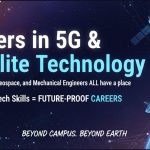
Careers in 5G and Satellite Technology: What Engineering Students Need to Know
The future of connectivity is no longer confined to mobile towers and fiber cables—it now stretches from dense urban networks to low-Earth orbit. With 5G rolling out at scale and satellite technology powering global communication, navigation, and surveillance, engineering students are stepping into one of the most exciting career eras of this decade.
These two domains are not just “next big things”; they are foundational technologies shaping smart cities, autonomous vehicles, space missions, defense systems, and disaster communication.
| Join Telegram For Fast Update | Join |
Why 5G and Satellite Tech Are Career Goldmines
Engineering students who align early with these fields gain access to roles that are high-impact, high-growth, and globally relevant.
Key career advantages include:
- Explosive demand: Telecom companies, space agencies, startups, and defense organizations are actively hiring.
- Cross-disciplinary roles: Opportunities span electronics, computer science, mechanical, aerospace, and data engineering.
- Global relevance: Skills are transferable across countries and sectors.
- Future-proof growth: These technologies will evolve for decades, not years.
Core Skills Engineering Students Should Build
To enter 5G and satellite technology careers, students must go beyond classroom theory.
Essential skills include:
- Strong fundamentals: RF engineering, signal processing, electromagnetics, and digital communication.
- Networking knowledge: 5G architecture, cloud-native networks, SDN/NFV.
- Software proficiency: Python, MATLAB, C/C++, and simulation tools.
- Space basics: Orbital mechanics, satellite subsystems, telemetry, and tracking.
- Emerging tech awareness: AI in network optimization, IoT integration, and cybersecurity.
Career Paths You Can Explore
Engineering students can choose diverse roles depending on their specialization:
- 5G Network Engineer
- RF & Antenna Design Engineer
- Satellite Systems Engineer
- Space Mission Operations Analyst
- Telecom Software Developer
- Defense & Aerospace Engineer
- Research Scientist in Wireless or Space Tech
Internships with telecom operators, ISRO-linked projects, startups, and global research labs add powerful credibility.
How to Prepare While Still in College
- Participate in hackathons and tech competitions
- Work on mini-projects using SDR, IoT, or satellite data
- Earn certifications in 5G, networking, or space systems
- Follow industry whitepapers and global tech missions
FAQs
- Is 5G only for electronics and telecom engineers?
No. Computer science, data science, mechanical, and aerospace engineers also play critical roles. - Do satellite technology careers require space agency experience?
Not necessarily. Private space startups and defense firms offer strong entry-level roles. - Are these careers future-safe?
Yes. With 6G research, satellite internet expansion, and space exploration rising, demand will only increase.
For the latest update about Govt. Job, please follow our Facebook, Telegram, What’s app channel & Instagram